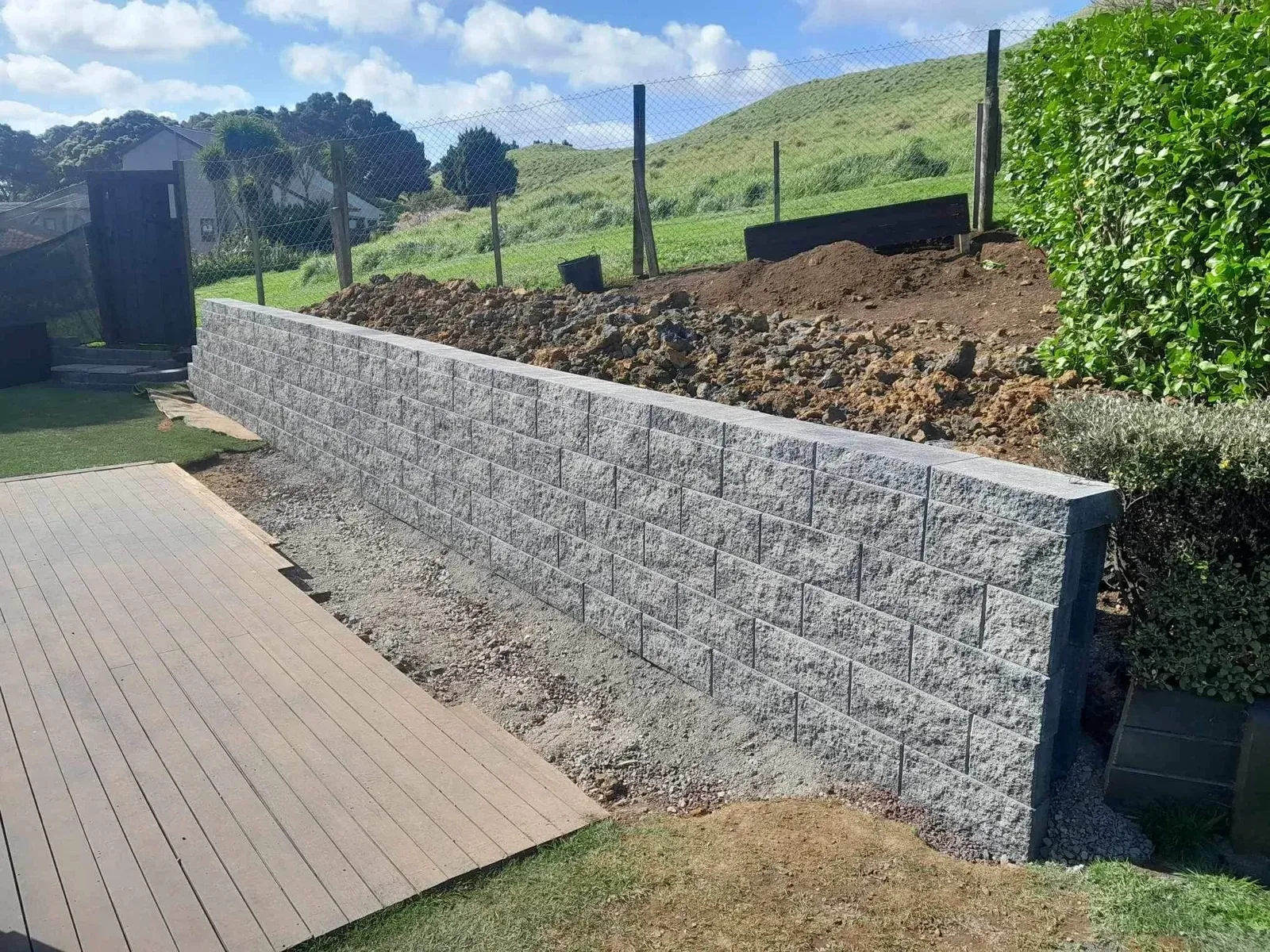
Keystone Retaining Walls in Auckland
Keystone interlocking block retaining walls for Auckland properties, gravity walls, geogrid-reinforced walls, and terraced designs built for hilly terrain and clay soils.
Our Keystone wall specialists install keystone retaining walls across Auckland for residential, commercial, and rural properties. Keystone interlocking concrete blocks are well-suited to Auckland's hilly terrain and heavy clay soils, from gravity walls on gentle slopes to geogrid-reinforced structures holding back steep banks.
What are Keystone Retaining Walls?
Keystone retaining walls use interlocking concrete blocks that lock together through a pin-and-socket connection, creating a gravity-based structure that resists earth pressure through its own mass and setback angle. For taller walls or heavier loads, geogrid reinforcement layers are tied into the block courses and extend back into compacted fill behind the wall, anchoring the structure into the retained earth itself. We install Firth Keystone blocks in a range of face profiles and colours, handling everything from engineer design coordination and building consent through to excavation, drainage installation, block laying, geogrid placement, backfill compaction, and finished capping. Retaining walls over 1.5 metres in New Zealand require building consent and must meet MBIE's Building Code structural stability requirements.
- Gravity keystone walls for residential sections and garden terracing
- Geogrid-reinforced keystone walls for heights over 1.5 metres
- Curved and terraced keystone wall designs for natural-looking slopes
- Proper drainage aggregate and subsoil drainage behind every wall
- Engineer design coordination and Auckland Council building consent
- Firth Keystone blocks in multiple face textures and colour options Installing keystone retaining walls across Auckland from our Coatesville base.
We've been building retaining walls across Auckland for over 25 years, and keystone block is the system we reach for on any job where the wall needs to outlast the property owner. Property owners in Albany, East Tamaki, and Glen Eden have relied on us for keystone walls that hold ground on steep sites and clay soils without drama.
When You Need Us
When You Need Keystone Retaining Walls in Auckland in Auckland
Steep Section Needs a Tall Retaining Wall
Your hillside section has a steep bank that needs holding back to create a usable building platform or outdoor area. A geogrid-reinforced keystone wall has the structural strength for heights over 1.5 metres, engineered for the soil pressure and surcharge loads on your specific site.
Garden Terracing on a Sloping Property
Your sloping garden is hard to use and loses soil downhill every time it rains. A series of stepped keystone retaining walls creates flat, usable terraces while adding a clean, finished look to the landscape, with proper drainage behind each wall to handle Auckland's rainfall.
Replacing a Failing Timber Retaining Wall
Your old timber retaining wall has rotted, leaned forward, or broken apart. A keystone block replacement will outlast timber by decades, concrete blocks don't rot, warp, or attract borer, and the finished wall looks better from day one.
Driveway or Parking Area Retaining
Your driveway or parking area sits above or below the surrounding ground and needs a retaining wall to hold the level change. Keystone blocks handle the surcharge load from vehicle traffic, and the block face holds up well against vehicle proximity without deteriorating.
New Build Site Requires Engineered Retaining
Your new home requires retaining walls as part of the building platform construction. The engineer has specified a block retaining wall system with geogrid reinforcement to support the building pad and manage the cut-and-fill transitions on the site.
Boundary Retaining Wall Between Properties
The level difference between your property and the neighbour's needs a retaining wall along the boundary. A keystone wall gives a neat, low-maintenance boundary structure that both properties benefit from.
Curved Retaining Wall for Natural Contours
Your site has natural contours that don't suit a straight wall line. Keystone blocks can be laid in curved alignments to follow the shape of the land, creating a wall that looks intentional rather than forced against the terrain.
Commercial or Multi-Unit Development Retaining
A commercial site or multi-unit residential development needs retaining walls across multiple areas, cut batters, building pad edges, carpark boundaries, and accessway retaining. Keystone block walls give a consistent, low-maintenance finish across the entire development.
Our Process
Our Keystone Retaining Walls in Auckland Process
Blake Civil Construction follows a systematic approach for every keystone retaining walls in auckland project.
Site Assessment and Design
We inspect the site to assess bank height, slope angle, ground conditions, drainage paths, and any loads above or below the proposed wall. For walls that need engineering, we work with a structural or geotechnical engineer to produce a design specific to your site conditions.
Building Consent (Where Required)
Auckland Council requires building consent for retaining walls over 1.5 metres high, or walls at any height that support a surcharge load such as a building, driveway, or neighbouring property. We prepare the consent documentation, including engineer drawings and specifications, and manage the application.
Excavation and Foundation Preparation
We excavate the wall foundation trench to the specified depth and width, removing any unsuitable material. The foundation is levelled and compacted, then a compacted aggregate base pad is placed to give the first course of blocks a level, stable surface to sit on.
Block Installation and Geogrid Placement
Keystone blocks are laid course by course with the interlocking pins providing setback and alignment. For reinforced walls, geogrid layers are placed at specified course heights, extending back into the compacted fill zone behind the wall. Each course is levelled and checked before the next goes down.
Drainage and Backfill
Drainage aggregate is placed behind the wall face with filter cloth separating it from the retained soil. A subsoil drain at the base collects water and directs it to an outlet. Backfill is placed in layers and compacted to the engineer's specification to prevent settlement behind the wall.
Capping and Site Completion
Cap blocks are fixed to the top course to finish the wall and prevent water entry into the block cores. The area above and below the wall is graded, topsoiled, and left ready for landscaping or the next stage of construction.
Need a Quote for Keystone Retaining Walls in Auckland?
Get in touch for a free, no-obligation quote on your project.
Why Choose Us
Why Choose Blake Civil for Keystone Retaining Walls in Auckland?
Pin-and-Socket Interlocking System
Keystone blocks lock together through a pin-and-socket connection that provides consistent setback and alignment at every course. Each block transfers load to its neighbours, the wall acts as a single gravity mass rather than a stack of independent units.
Geogrid Reinforcement for Heights Over 1.5m
Taller keystone walls and walls carrying surcharge loads use geogrid reinforcement layers tied into the block courses and extending into compacted fill behind the wall. This anchors the structure into the retained earth for heights and loads that gravity alone can't handle.
Drainage Aggregate Behind Every Wall
Hydrostatic water pressure is the main reason retaining walls fail on Auckland's clay soils. We install drainage aggregate, filter cloth, and subsoil drains behind every keystone wall, taking the pressure off before it can push the blocks forward.
Concrete Blocks. No Rot, No Borer, No Painting
Keystone concrete blocks don't rot like timber, rust like steel, or attract borer. Once installed, the wall needs no painting, staining, or chemical treatment, it performs for decades with minimal maintenance beyond keeping drainage outlets clear.
Firth Colour and Texture Range
Firth Keystone blocks come in multiple face textures and colours, natural grey, charcoal, and earthy brown tones. The wall complements surrounding landscaping and house cladding rather than sticking out as an industrial structure dropped into the garden.
Curved and Terraced Wall Layouts
Unlike poured concrete walls, keystone blocks can be laid in curved alignments and stepped terraces to follow natural site contours. This produces walls that look like they belong on the property rather than being imposed on it.
Related Keystone Retaining Walls in Auckland Services
Blake Civil Construction provides services that complement our keystone retaining walls in auckland expertise.
Timber Retaining Walls
Treated timber retaining wall construction for residential properties.
Retaining Wall Installation
New retaining wall construction for residential and commercial sites.
Retaining Wall Repair
Retaining wall repair, stabilisation, and rebuild services.
Hard Landscaping
Retaining walls, paving, steps, and outdoor structures.
Excavation & Grading
Precision excavation and grading for level building sites and drainage falls.
Keystone Retaining Walls in Auckland Coverage - Auckland Wide
Blake Civil provides professional keystone retaining walls in auckland services across the greater Auckland region.
Our Coatesville base provides rapid response across Auckland for residential, commercial, and industrial keystone retaining walls in auckland projects.
Contact Blake Civil for Professional Keystone Retaining Walls in Auckland
When your Auckland project requires professional keystone retaining walls in auckland, Blake Civil Construction delivers the experience, equipment, and expertise to complete it properly.
43 Mill Flat Road, Coatesville 0793
Keystone retaining wall installation across greater Auckland, from our Coatesville base serving residential, commercial, and rural properties throughout the region.
25+ years building keystone retaining walls across Auckland, interlocking block walls that hold ground for good.
Explore More
Related Services
More services from our Retaining Wall Contractor in Auckland category
Retaining Wall Installation in Auckland
New retaining wall installation for residential, commercial, and rural Auckland properties, engineered wall systems with proper drainage, built to handle steep terrain and clay ground conditions.
Retaining Wall Repair in Auckland
Repair and restoration of failing retaining walls across Auckland, leaning wall stabilisation, drainage fixes, full timber wall replacement, and block wall crack repair. We find the cause first, then fix it.
Timber Retaining Walls in Auckland
H4 and H5 treated timber retaining walls for Auckland residential and rural properties, pole walls, horizontal plank walls, and cantilever systems built with proper drainage for ground retention that actually lasts.
Ready to Start Your Next Project?
Contact Blake Civil Construction for expert earthworks services across Auckland. Our team is ready to discuss your project and provide a quote.