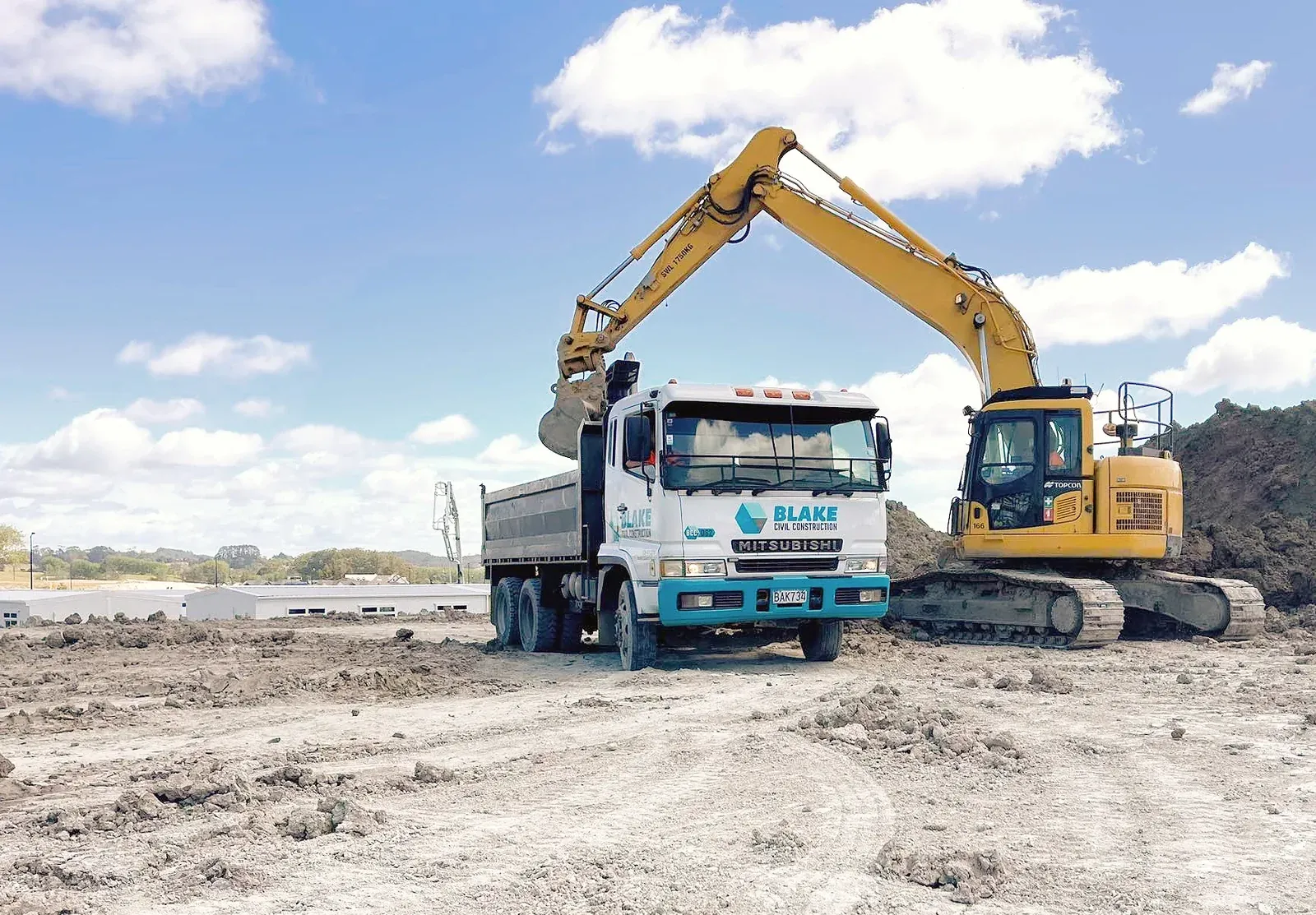
Consented Land Filling in Auckland
Controlled placement of approved fill material under Auckland Council resource consent conditions, compaction testing, environmental monitoring, and documentation for council sign-off.
Consented land filling involves more than moving dirt. Every load has to be checked, every layer compacted and tested, and every condition in the resource consent met. Blake Civil Construction manages the full filling process across Auckland for property owners, developers, and contractors who need to raise ground levels, fill low-lying sections, or dispose of excavated material under resource consent conditions. Consent compliance, material acceptance, placement, compaction, testing, and environmental controls, handled under one contractor.
What is Consented Land Filling?
Consented land filling involves the controlled placement of approved fill material on a site that holds a resource consent for filling operations. Unlike dumping material on vacant land, consented filling requires strict controls over what material is accepted, how it's placed, how it's compacted, and what environmental monitoring is carried out. Auckland Council issues these consents with specific conditions, and every one of those conditions has to be met. That's the job. Auckland Council's resource consent framework governs land filling thresholds, approved fill material categories, and the environmental conditions attached to consented fill operations.
- Resource consent condition compliance and documentation
- Clean fill and managed fill acceptance under consent conditions
- Layer-by-layer placement with controlled lift thickness
- Compaction to NZS 4431 for engineered building platforms
- Sediment and erosion control during filling operations
- Environmental monitoring and council reporting Operating consented fill sites across Auckland for residential, commercial, and rural development projects.
Running a consented fill site to council conditions takes systems, not guesswork. Property owners in Millwater, Otahuhu, and Hobsonville have been trusting Blake Civil Construction to manage that compliance for over 25 years.
When You Need Us
When You Need Consented Land Filling in Auckland in Auckland
Low-Lying Section Needs Raising Before Building
Your section sits below the required building platform level and needs fill to bring it up to grade. We place approved material under consent conditions, compact in layers, and provide the documentation your engineer needs to certify the pad for building consent.
Excavated Soil Needs a Legal Disposal Site
Your earthworks project has generated surplus soil that can't stay on site. We accept material at our consented fill sites where it meets the consent acceptance criteria, a compliant disposal option that keeps your programme moving.
Developer Preparing Multiple Lots on Filled Ground
A subdivision requires several lots to be brought up to finished level with imported fill. We manage the filling programme across all lots, coordinating material deliveries, compaction, and testing to keep the development on schedule.
Rural Property Needs Land Improvement
A rural block has low-lying areas, boggy ground, or uneven terrain that needs filling to make it usable. We handle the consent conditions and fill operations to improve the land for grazing, access tracks, or future building platforms.
Filling Around Completed Retaining Walls
New retaining walls have been built and the area behind or in front needs backfilling to design levels. We place and compact approved fill in controlled layers to protect the wall structure and meet the engineering specification.
Contaminated Site Requiring Managed Fill Disposal
Material from a remediation project or demolition site contains construction waste that doesn't qualify as clean fill. We accept managed fill at consented sites where the consent allows controlled placement of these materials with appropriate environmental monitoring.
Stormwater Detention Area Needing Engineered Fill
A stormwater management design requires specific areas to be filled to precise levels. We place fill to the design grades your engineer has specified, with compaction and testing to confirm the formation meets the structural requirements.
Consent Holder Needing an Experienced Fill Operator
You hold a resource consent for filling but need an operator who knows the conditions and can manage the work to compliance standards. We take on the operational management, material acceptance, placement, compaction, environmental controls, and reporting.
Our Process
Our Consented Land Filling in Auckland Process
Blake Civil Construction follows a systematic approach for every consented land filling in auckland project.
Consent Review and Site Assessment
We review your resource consent conditions, site plans, and engineering specifications. This identifies the approved fill types, volume limits, compaction standards, environmental controls, and reporting requirements that apply to your site. Everything we do after this point flows from understanding these conditions properly.
Environmental Controls Installation
Before any fill arrives on site, we install sediment and erosion controls, silt fences, stabilised entry points, sediment ponds, and dust suppression measures as required by your consent conditions. These go in first, not as an afterthought.
Material Acceptance and Quality Control
Every load of fill delivered to site is checked against the consent acceptance criteria. Clean fill must be natural materials only, soil, rock, gravel, clay. Managed fill sites have specific criteria for what construction materials can be accepted. Non-compliant loads are rejected at the gate.
Layer Placement and Compaction
Approved fill is placed in controlled layers (typically 150mm to 200mm loose thickness) and compacted with rollers matched to the material type. Each layer is compacted before the next lift goes down, following NZS 4431 where engineered fill is specified.
Testing and Verification
Density testing is carried out at required intervals using nuclear density gauge or other approved methods. Test results confirm each layer meets the target compaction standard. All results are documented and compiled for engineer review, this is what certification depends on.
Documentation and Council Reporting
On completion, we compile all records, material acceptance logs, compaction test results, environmental monitoring data, and volume tracking. This documentation satisfies your consent conditions and gives your engineer the evidence needed for certification.
Need a Quote for Consented Land Filling in Auckland?
Get in touch for a free, no-obligation quote on your project.
Why Choose Us
Why Choose Blake Civil for Consented Land Filling in Auckland?
Consent Condition Compliance Built In
We work within Auckland Council resource consent conditions for filling operations regularly. Our team tracks material acceptance criteria, volume limits, compaction standards, and environmental monitoring requirements specific to your consent, not a generic approach applied to every site.
Load-by-Load Material Acceptance
Every truck of fill arriving on site is checked against your consent acceptance criteria before it tips. Non-compliant loads are rejected. Clean fill sites take natural materials only. Managed fill sites follow their specific criteria for construction materials. This is where compliance is either maintained or lost.
Engineered Fill to NZS 4431
When your consent requires engineered fill platforms, we place material in 150-200mm controlled layers, compact with matched rollers, and coordinate density testing at every interval. Your building platforms pass geotechnical inspection because the work is done right, not just documented.
Sediment and Dust Controls Maintained
Filling operations expose large areas of bare ground. We install and maintain silt fences, stabilised entrances, sediment retention, and dust suppression throughout the project, documenting compliance for council reporting at every stage.
Complete Paper Trail for Council
Every load accepted, every layer placed, every test result recorded. We compile material acceptance logs, compaction records, and environmental monitoring data into the documentation Auckland Council requires to confirm all consent conditions are met.
Excavators, Trucks, Rollers, and Graders On-Site
From receiving and spreading incoming fill to final compaction and surface trimming, our fleet handles every stage of the filling operation. One contractor managing the full scope keeps your fill programme moving at any scale.
Related Consented Land Filling in Auckland Services
Blake Civil Construction provides services that complement our consented land filling in auckland expertise.
Subdivision Bulk Earthworks
Large-scale cut and fill operations for subdivisions and commercial sites.
Fill Platform Compaction
Ground compaction to engineering specs for building platforms and driveways.
Clean Fill Disposal
Clean fill and managed fill placement on designated landfill sites.
Contaminated Soil Removal
Contaminated soil removal and treatment to environmental standards.
Fill Cartage Truck Hire
Tip truck with operator for carting soil, aggregate, and demolition material.
Consented Land Filling in Auckland Coverage - Auckland Wide
Blake Civil provides professional consented land filling in auckland services across the greater Auckland region.
Our Coatesville base provides rapid response across Auckland for residential, commercial, and industrial consented land filling in auckland projects.
Contact Blake Civil for Professional Consented Land Filling in Auckland
When your Auckland project requires professional consented land filling in auckland, Blake Civil Construction delivers the experience, equipment, and expertise to complete it properly.
43 Mill Flat Road, Coatesville 0793
Serving consented land filling projects across greater Auckland, residential sections, subdivisions, commercial sites, and rural properties.
Family-owned, Coatesville-based. 25+ years running consented fill operations from first load to final sign-off.
Explore More
Related Services
More services from our Earthworks Contractor Auckland category
Building Pad Preparation in Auckland
Building pad preparation for new homes, townhouses, and commercial buildings across Auckland, cut and fill, compaction to spec, and platforms that pass testing first time on sloped and clay-heavy sections.
Bulk Earthworks in Auckland
Large-scale cut and fill moving thousands of cubic metres for subdivisions, commercial developments, and infrastructure projects across Auckland.
Civil Construction Earthworks in Auckland
Infrastructure-scale earthworks for roads, subdivisions, and commercial sites across Auckland. We've been doing this work for over 25 years and we know how to keep civil programmes on track.
Compaction Services in Auckland
Ground compaction for building pads, driveways, and subdivisions. Fill placed to spec, rolled properly, tested so you pass first time and keep the project moving.
Excavation and Grading in Auckland
Cut and fill, site levelling, and GPS-guided grading to finished levels for new builds, commercial developments, and rural sections across Auckland.
Land Clearing in Auckland
Full site clearing for rural sections, lifestyle blocks, and greenfield development. Vegetation removed, stumps ground, debris disposed of, and the land ready for construction.
Ready to Start Your Next Project?
Contact Blake Civil Construction for expert earthworks services across Auckland. Our team is ready to discuss your project and provide a quote.